Vehicle Barrier System Testing Saves Owners Money
Project Background
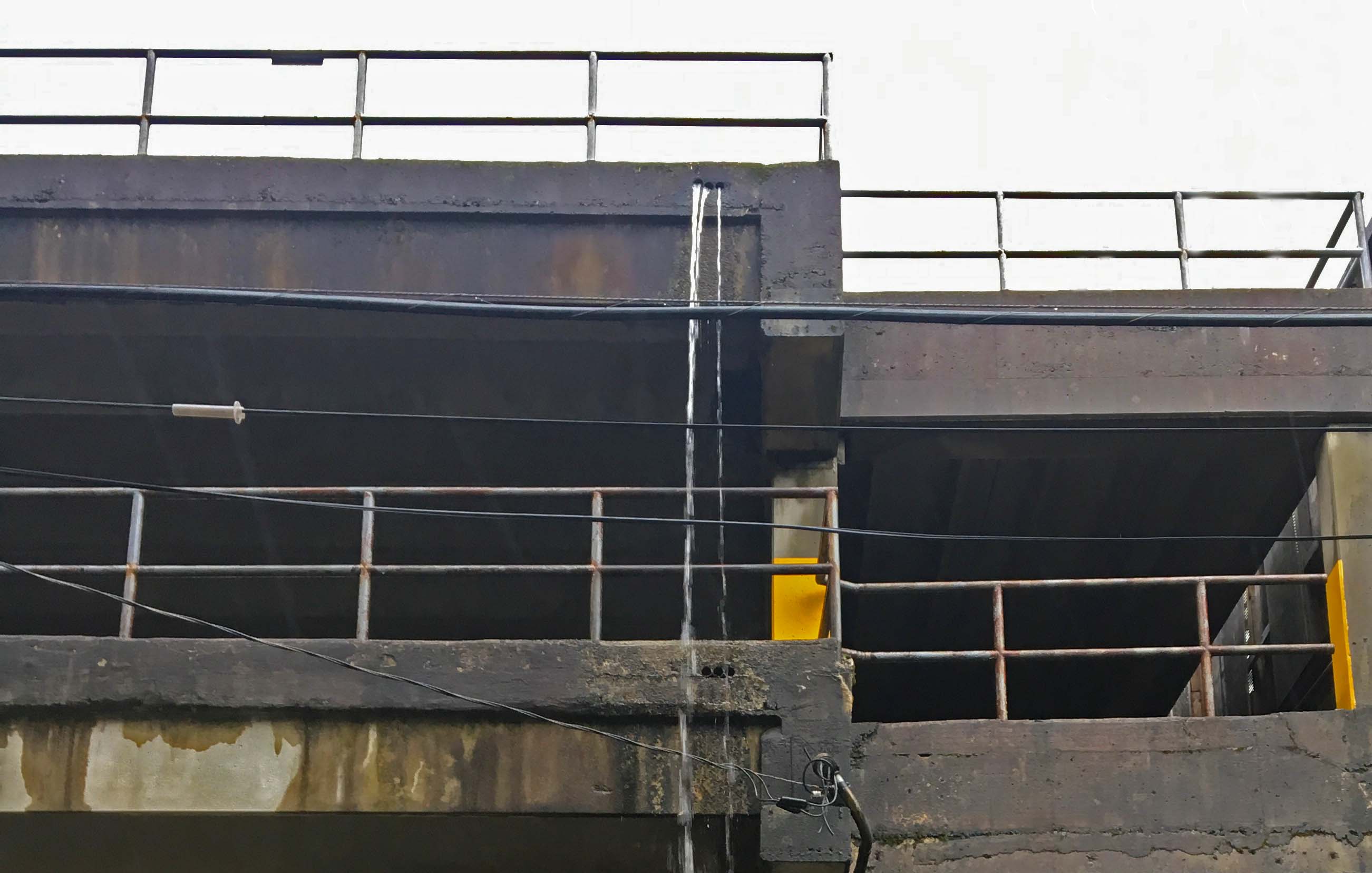
A client recently purchased an office building and while completing their due diligence, decided that the attached parking structure needed restoration work. The client hired Innovative Engineering Inc. for restoration engineering and to determine if the structure met code requirements.
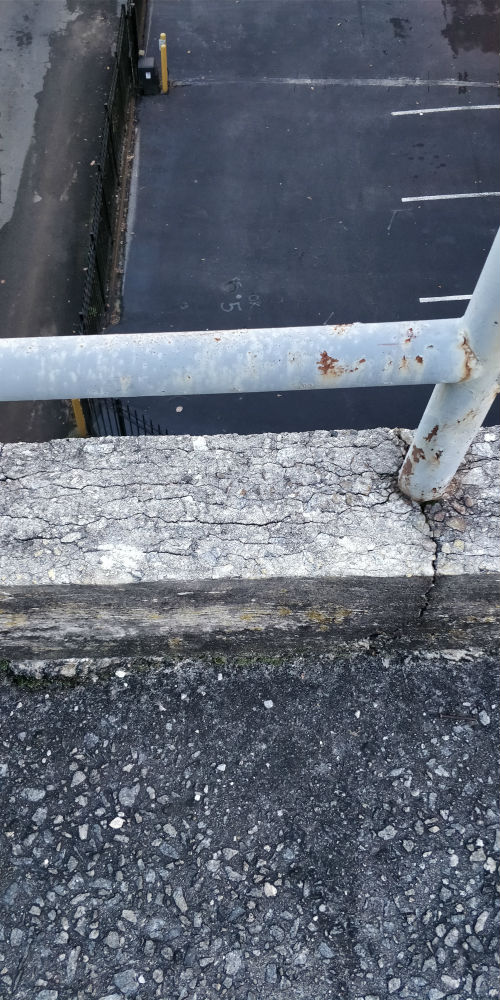
At first glance, the vehicle guardrail system, composed of steel pipe embedded into a concrete curb, seemed as though it would not meet code. It resembled an OSHA guardrail, but it was too short, openings were too large, and, due to the very small edge distances and general condition of the barrier system, it appeared it would not pass a load test.
Due to these shortcomings, the client received a quote of $370,000 to replace the barrier system with one that met code. Rather than the owner paying over one-third of one million dollars, Innovative Engineering suggested performing a load test on the barrier.
Upon completion of the load tests, it was determined that the vehicle barrier system could withstand the load and would only need relatively inexpensive modifications to meet the height and maximum opening requirements.
Why does my old building need to meet the new code?
There are a couple of common triggers that require an older building to meet the current building code. One trigger is an increase in occupancy type, for example, going from a Business office to an Assembly. The second common trigger is renovation cost. In accordance with the Georgia 2014 IBC Amendment 3401.7.2 if the cost of the new work exceeds 50% of the building replacement cost, the entire facility must be brought up to current code.
Why load test my vehicle barrier if it won't meet the other code requirements?
Replacing the vehicle barrier system on an entire parking structure is a very expensive project. Before replacing the vehicle barrier due to height or opening issues, consider load testing the system first.

If the barrier system passes the load test, the system can be brought to current code height and opening size with engineered details. Additional members can be attached to the top of the rail to meet the 42-inch height requirement and panels can be attached between guard rail posts to lower the maximum opening size to 4 inches or less. These repairs can be completed at a fraction of the cost of replacement and are often a much quicker solution as well.
Vehicle Barrier Testing Procedure
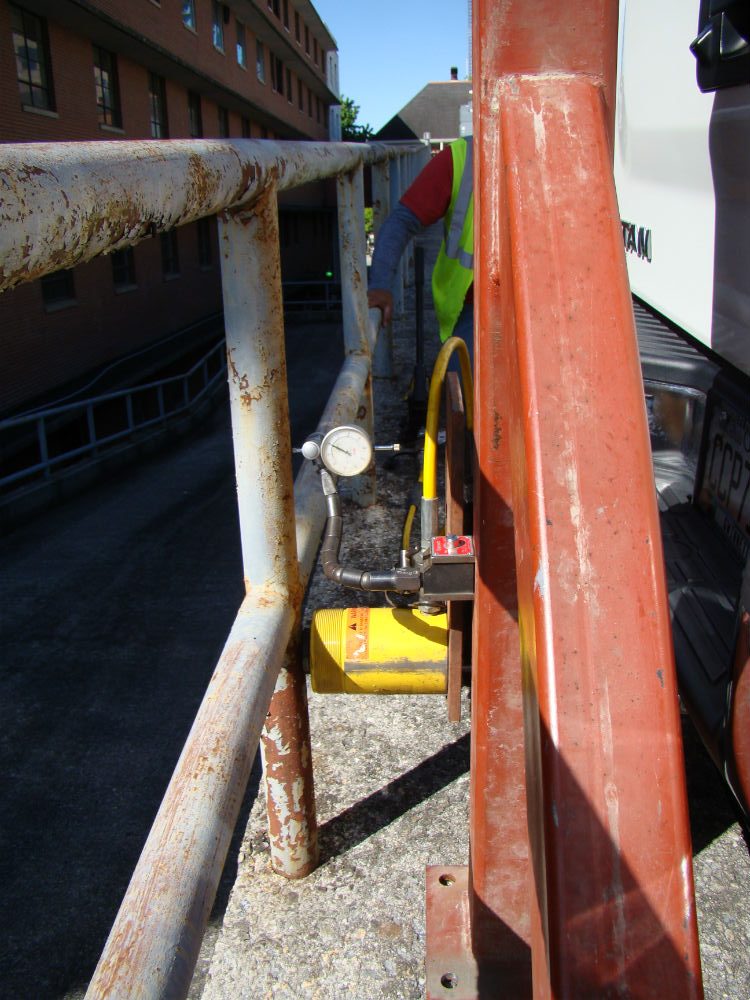
Per ASCE 7-10 4.5.3 and IBC 2015 1708.3.2, a load of 9,600 pounds is to be applied in any direction at a height between 1'-6" and 2'-3" and left in place for 1 minute. To accomplish this loading requirement without drilling dozens of holes throughout the deck for anchorage, a truck mounted jack was used. This method saved the owner hours of labor cost and no clean up work was required.
The entire parking deck is walked to determine appropriate testing locations and a quantity that will represent the overall structure. At each testing location, the truck backs up to the vehicle post where a dial gauge affixed to an independent frame measures the deflection of the post at quarter points of the testing load.
Quantifying Results
For the barrier system to pass, it must meet the following IBC requirements: deflection shall not exceed limitations in IBC 1604.3, the guardrail must recover at least 75% of max deflection within 24 hours of the load test, and the structure shall show no signs of failure. There is no code specified deflection limit for vehicle barriers as barriers are intended to be free to deflect in order to absorb the vehicle impact energy. For this reason, maximum deflection is the least significant of the three requirements.
The most critical and most difficult to remediate is total failure of the barrier i.e. if the guardrail breaks or the anchorage of the guardrail to the deck fails. If this occurs, details can be generated to reinforce the system, but the repairs may be more costly than replacement.
IEI was started by structural engineers, program managers and construction managers and has not lost touch with its roots in the design and construction industries. The core business at IEI will always be building design, including parking structures, which serves to strengthen our specialty in Parking Structure Restoration. Our engineers therefore have a wider variety of experience which equips them with a wider variety of time tested, innovative solutions to restoration challenges in their quiver. Contact IEI today about your challenges and receive a free no obligation walk-through of your facility.
IEI has spoken to BOMA Georgia Technical Organization (BTO) and authored an article for BOMA Georgia Insight Magazine on the topic of Parking Structure Maintenance and Restoration. Visit our articles and publications page for copies of the presentation.